














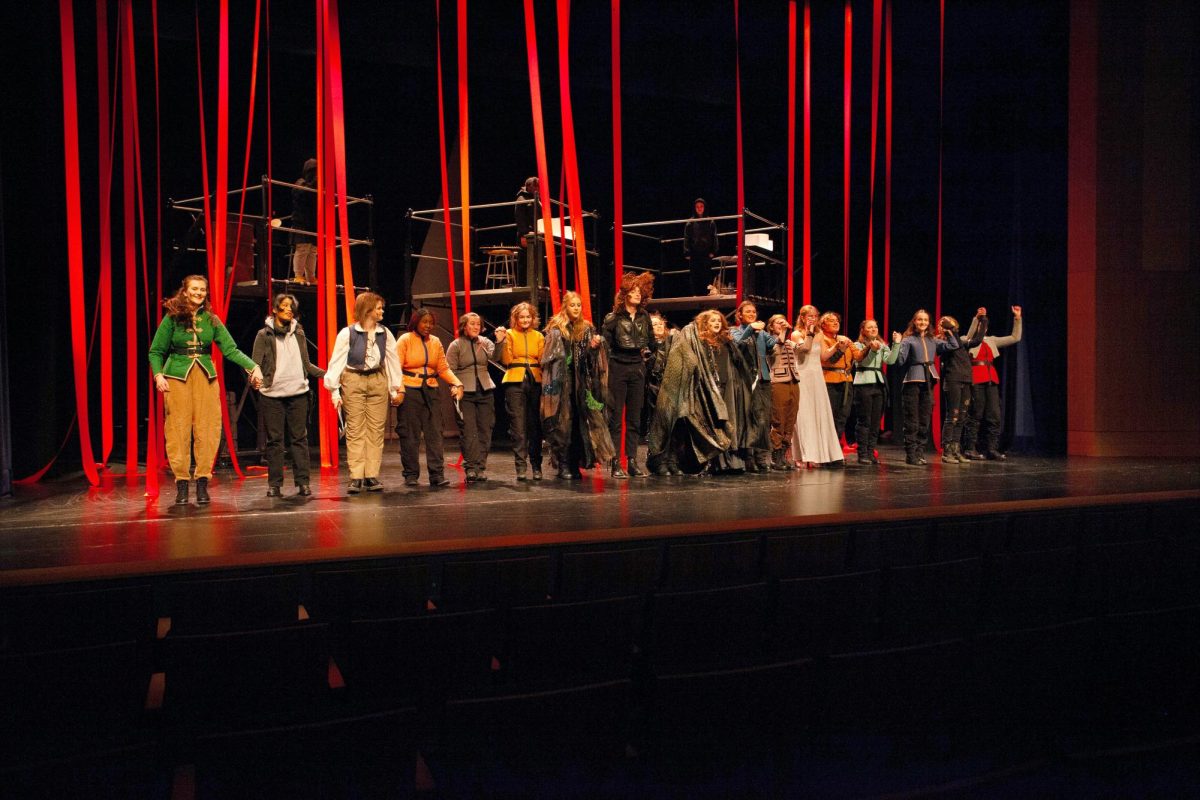
Opening and ending in darkness, Macbeth by William Shakespeare is a play wrapped in guilt, murder, and the supernatural. Human nature becomes dissected, and an entire system of belief crumbles in this well-known tragedy. The play was performed at Stone Ridge in the Cokie Roberts Theater on December 4, 5, and 6, 2025.
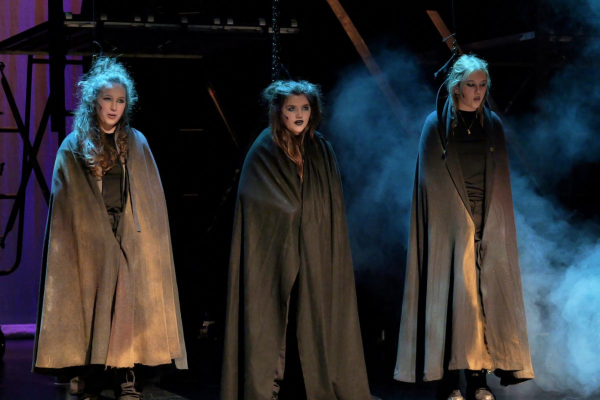
Immediately, an unearthly feeling is set as the Weird Sisters (Mattie Oliver, Isla Allen, and Frannie Hittle) join together to discuss their next meeting. Oliver, Allen, and Hittle are enticing; in every one of their scenes the audience cannot help but be pulled into their cryptic words, unsettling laughter, and echoing stage presence, so of course Macbeth would be pulled in too. Instantly the Three Witches vanish, and the lights brighten as more characters gather on stage, including Duncan, King of Scotland (Lena Turner), Malcolm, Duncan’s oldest son (Charle Gaughan), and Donalbain, Duncan’s youngest son (Eleanor Chadwick). The set is minimal, with three structures blending into the darkness, but it works well by not crowding up the stage and distracting from the dialogue and acting.
Soon afterward, Macbeth (Addison Webb) enters with Banquo (Ella Loudermilk), and it is evident that they are close friends. As they stumble upon the witches, the possibility of being king is introduced to Macbeth, but whether this was set in stone or a simple suggestion, the events of the play latch on to the seeds the witches have planted about the future. Webb portrays Macbeth’s wide range of emotions across the play brilliantly, and right now he is shocked, scared, yet also intrigued at the possibility of being Thane of Cawdor; being king, though, seems to be a stretch. Malcolm is then declared Prince of Cumberland, and when it is announced that Macbeth is to be the Thane of Cawdor, he slowly but surely falls into the darkness of possibilities the Witches have laid out for him.
Lady Macbeth (Olivia Tallamy) enters soon after, receiving word of Macbeth’s new title and the prophecy that it is very possible he could be king. Lady Macbeth has ambition, which she understands her husband lacks, and Tallamy delivers a haunting portrayal of a character who yearns to transcend her natural state; all in all, this is a regal performance, and Tallamy speaks with such command that every monologue is a spell. “Come, you spirits /” she says, “That tend on mortal thoughts, unsex me here, / And fill me from the crown to the toe top-full / Of direst cruelty.” After all, Lady Macbeth is the one who then forms the plan and convinces Macbeth to commit the murders himself, starting with murdering Duncan when he and his party visit the Macbeths’ that night.
After killing Duncan, Macbeth has now plunged his world into an endless night, and with blood on his hands, he spirals to Lady Macbeth about the plot they have just conspired. Webb and Tallamy do a great job of balancing feelings of guilt and cold calculation with one another, while also portraying how close the relationship between the two characters are. After this first murder, a red ribbon slips down from the sky, and a few more drop after the entire party finds Duncan dead.
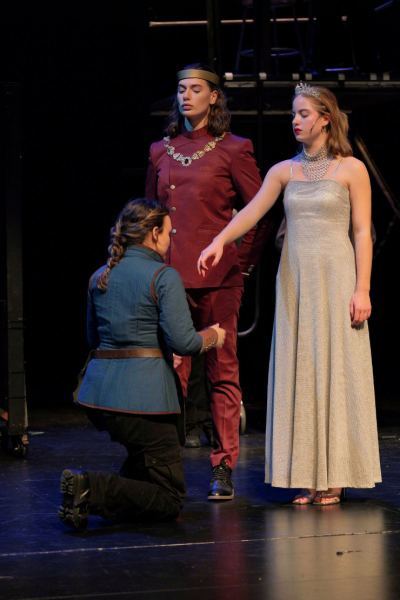
Loudermilk gives an emotional performance as Banquo, who also has his own prophecy from the witches that his offspring will become kings. But after the first murder, the friendship between Banquo and Macbeth has now changed. As Macbeth and Lady Macbeth emerge in royal dress, now that Duncan’s death has led to their being king and queen, they make Banquo kneel and kiss their hands. Webb and Tallamy are solemn, tall, cold. Macbeth cannot seem to stop paranoia seeping into his relationships and desire to become, and stay, king. Banquo will be his next victim, and two murderers (Eleanor Chadwick and Carla Barahona) slit Banquo’s throat which is marked by another red ribbon dropping down. It was truly a tension filled scene, as the Banquo did not deserve to die, yet becoming king has unacquainted Macbeth with reason.
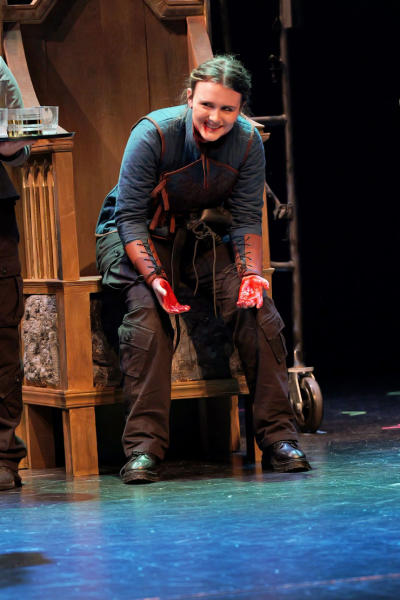
Later on, at a dinner party at the Macbeths’, a throne is brought out for Macbeth to sit upon, only for Webb to utter a blood-curdling scream as Loudermilk appears once more, only this time as Banquo’s ghost. Having Banquo’s hands be bloody, with handprints on his neck, was chilling, and Loudermilk does well by amping up the gore and despair as she haunts the stage. Macbeth is not safe, not from his identity, guilt, and actions, and Webb does well portraying how horrified Macbeth is at seeing this phenomenon that none of his guests can see. “It will have blood, they say; / blood will have blood” Macbeth declares, stricken with grief at seeing the ghost, and the Witches look over the scene from their place in the three structures in the background.
Macbeth then meets with the Witches to determine his brutally acquired kingship is safe from harm, leading to three declarations as to how he must be cautious of Macduff, men born from women, and Birnam Wood. Macbeth decides the murder of Lady Macduff, Macduff’s wife (Nicole Kaleem) and Young Macduff, Macduff’s son (Coco Patterson) will aid in helping him overpower Macduff, and elsewhere, Malcolm and Macduff reach the conclusion that they will attack Macbeth with help of English forces. More red ribbons fall with the murder of Macduff’s family, and the stage is close to being littered with red.
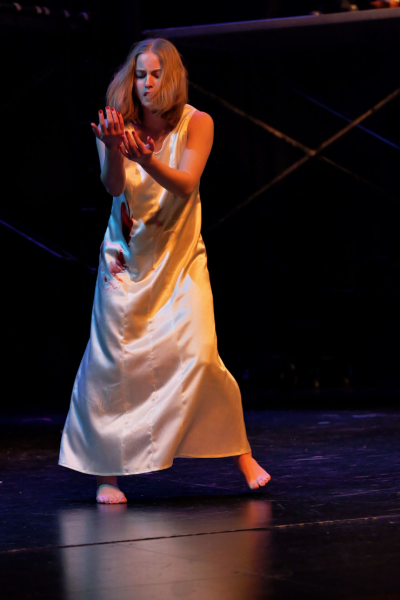
Meanwhile, the once stoic Lady Macbeth is plagued by sleepwalking and guilt as she continually washes her hands, tortured by the fact that she cannot start over. A technique is then used to make it seem like blood has emerged to stain her hands and white nightgown, as Tallamy delivers Lady Macbeth’s final words before her suicide with such restlessness. “What’s done cannot be undone” (5.1.71) she utters in this memorable scene.
As before, Macbeth is a mix of many emotions, and though he begins with questioning murder, he wades deeper into blood until he is dressed in black and a cold persona; by the end of play, he seems to be dead inside, though alive physically. Murder is a deed he cannot escape, and more red ribbons keep crowding the stage.
The final act is full of impressive sword-work and knife-work, resulting in two noteworthy scenes between Macbeth and young Siward (Ellie Goldberg) and between Macbeth and Macduff (Marina Romero), who channels the pain from losing his family into a nail-biting fight. Macbeth almost seems to overpower Macduff’s advances, but the Witches’ prove to be correct in the fact Macduff is the one who overcomes Macbeth. Yes, Macbeth is killed, but not before Webb drags out the final breath by clawing the stage floor, and then collapsing, adorned in the red ribbons she dragged down with her.
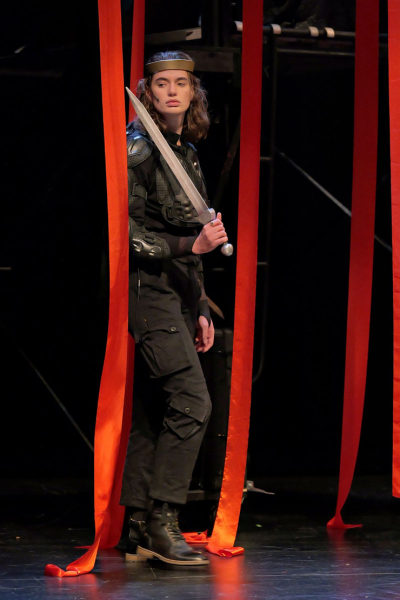
Everything has changed, and Malcolm is now king, with Gaughan delivering the last lines of dialogue with a wide-eyed, shaken expression. When the play ends, how reality will go on after the events that have transpired here? The witches then gather together one last time amid a stage strewn with red ribbons; nothing is the same as it was, and as they take one last breath, the lights go out and the play ends with them just as it began.
The costumes are fabulous, and the sound design team (Ndeji Omekongo, Kate McCreary, and Althea Feleke) did an excellent job with the sound effects on stage. The drumming, bells, and knocking helped form the eerie atmosphere that the script, set, and actors also provoke. The touch of the red ribbons was just as good in symbolizing the journey human nature takes over the play; while the stage is bare of blood in the beginning, at the end, murder and guilt have taken over a clear conscience. It appears there is a fine line between what is considered human and animal instincts, and as Macbeth desired to become closer to divine, he took unnatural measures to achieve being king. So, what determines the natural and unnatural? The Macbeths’ want to be separated from kindness and morals so that they do not become dragged down by guilt and paranoia as a result of murderous acts, and yet they both are overcome by these implications. Identities can be shaped by social conditions, but how does one stay strong in the face of a reality where reason does not have any order, purposes do not hold any weight, and one must battle any temptations to become divine with the human conscious.
Macbeth displays just how normalized blood becomes once a person is constantly surrounded by it, but perhaps it is not worth destroying oneself for a crown. Blood can put a person somewhere, but it may not be on a throne. Sometimes, blurring the lines between human nature and animalistic instincts leads to a person collapsed on a stage, covered in guilt, violence, and a spilled identity.
Run time: 1 hour 45 minutes
Location: Cokie Roberts Theater, Mater Center